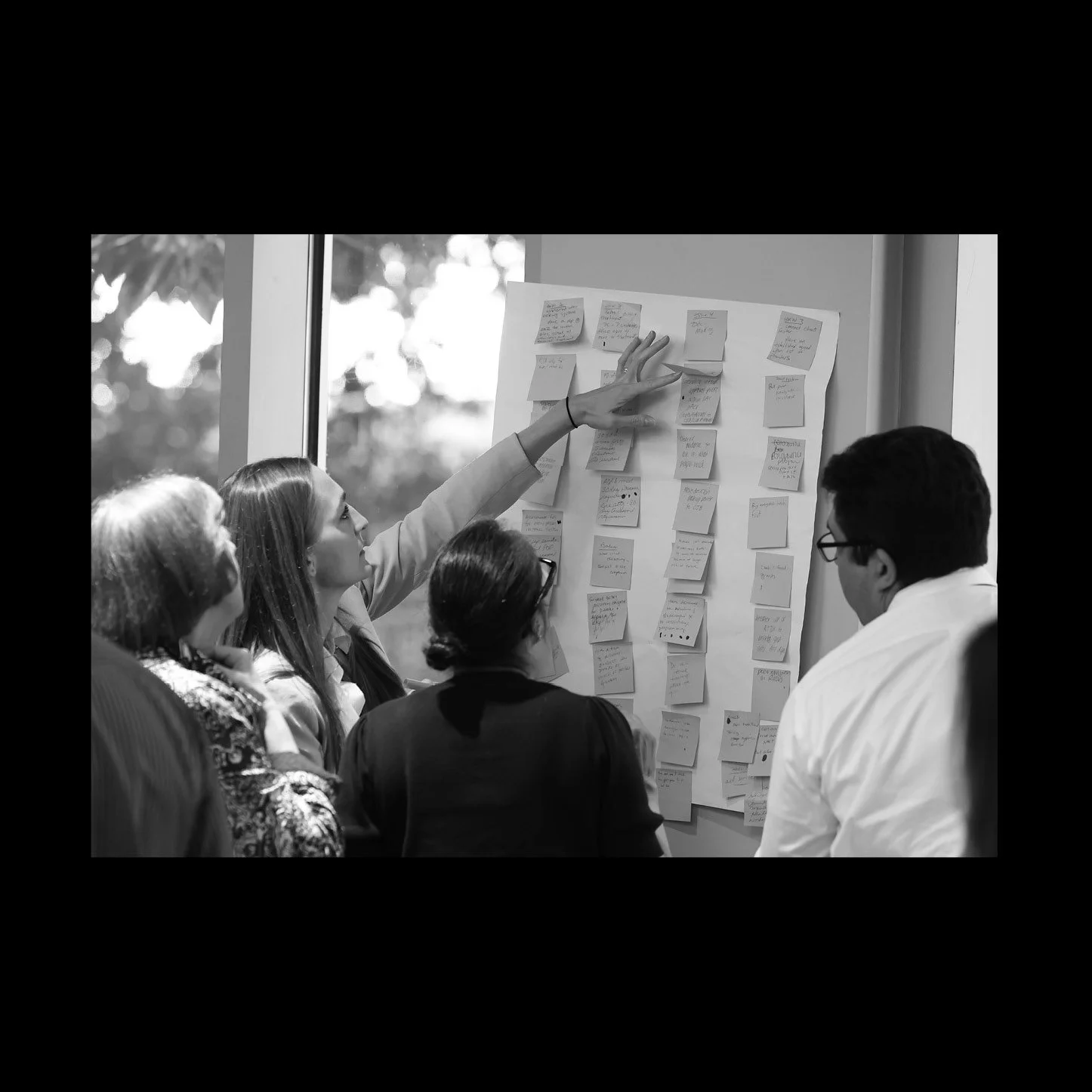
NASHVILLE — Teams from seven jurisdictions spent three days at Vanderbilt Law School this October working on some of the most stubborn problems in their justice systems: people waiting months to reach treatment, low-risk people held in jail before trial, crime victims who feel invisible, and young adults cycling back into jail after release.
The 2026 Justice Innovation Accelerator, held Oct. 6–9 by Justice Innovation Lab (JIL) and the Vanderbilt Project on Prosecution Policy (VPOPP), brought together teams from Bronx County, NY; Stanislaus County, CA; Arlington, VA; Norfolk, VA; the Northwestern District of Massachusetts; Wyandotte County, KS; and York County, PA. Each team included prosecutors, police, judges, defense attorneys, advocates and community members, and each left with a pilot plan to take home.
The Nashville workshop is part of the year-long program. One year after the 2025 Accelerator, all six jurisdictions in that cohort are still implementing the solutions they designed and are beginning to see results in their communities.
Here are 10 ways the Accelerator is changing justice.
1. We borrow good ideas from other fields.
The quickest way to innovate is to take someone else’s good idea, and bring it to a new context. We bring in interesting ideas from fields that have nothing to do with the justice system. This year participants heard from experts from fields such as improv comedy, robotics, sports, and music. From the sports panel, participants learned how they might use data to help with decision-making. From improv comedy, we learned how to take on a “yes, and..” mindset. And from the music session, we were reminded that during dark times, we must “Let It Shine!”
2. Everyone who touches the problem sits at the same table.
Most justice conferences put prosecutors with prosecutors and defenders with defenders. Accelerator teams represent decision makers from across the system. Avery McNeil of the Bronx Defenders said her team couldn’t have had these conversations in their usual stakeholder meetings. It took getting away from the office and being in a neutral space with exercises that got to root cause issues quickly.
3. We start with the people closest to the problem.
Teams spend their prework sessions interviewing the people their problem touches, including those who have experienced the system up close. Alaine Cawthon, who supervises victim advocates in Wyandotte County, KS, said her biggest lesson was that the circle needs to be wider. “Every decision that we make affects the people,” she told us. “So, getting the people that it affects in that room is so important.”
4. The clock is unfair on purpose.
Every exercise we run at the Accelerator has significant time constraints. Constraints spark creativity because, when the obvious paths are blocked, we are forced to search for unexpected solutions we would never have considered otherwise. Grace Woodward, director of Restorative Justice and Diversion Services in the Arlington County Commonwealth Attorney's Office, estimated her team got further in three days than they would have in a year’s worth of regular meetings.
5. Drawing the map shows you where to fix it.
“That was so obvious, I don’t know how I didn’t see that before.” We regularly hear this from teams after they complete a systems mapping exercise, in which teams identify bottlenecks, default settings and feedback loops that impact their problem. Wyandotte (KS) County District Attorney Mark Dupree described what a single bottleneck can cost: while a form waits on yet another approval, a person can lose their home or their child’s spot in daycare.
6. Small changes, existing resources.
We have seen over and over that thoughtful, targeted interventions can have outsized impact on a problem. Accelerator Teams are challenged to find a solution to their problem that requires no additional funding and no new laws. We encourage them to be “Shrimp Mothers.” Jennifer Suhl, Deputy District Attorney for the Northwestern District of Massachusetts, said the Accelerator exemplifies “the ability of a small group of people to make a big change.”
7. Victims get a more human process.
Three of this year’s seven teams focused on why victims of crime routinely stop participating in the prosecution process, which in some jurisdictions, happens in over half of all cases. Each pilot project centers on getting trauma-informed support to victims and survivors of crime, earlier in the process.
8. People reach treatment sooner.
In the Bronx, NY, it takes an average of 292 days for a case to reach one of the borough’s felony treatment courts. That’s nearly ten months for someone waiting for help. Through the Accelerator, the team designed an early referral process that puts the DA’s office, the court and the defense on the same page. Stanislaus, CA; York, PA; and Arlington, VA, counties are tackling related problems at different points in the process, from screening misdemeanors to supporting young adults coming home from jail.
9. Data breaks the ties.
As Vanderbilt Women’s Soccer Head Coach Darren Ambrose noted in his presentation, great players want to be told the truth. He shared how he used data to improve player performance, win more games, and rise to #1 in the country. At the Accelerator, every team leaves with a logic model, which lays out what they’ll do, what should change, and how they’ll know. Stanislaus County (CA) District Attorney Jeff Laugero said logic models were new to him. Asked what surprised him most, he answered: “That it worked.” York County (PA) District Attorney Tim Barker leads a team that spans the political spectrum. “We let data break our ties,” he said, “and we let data tell us when we are wrong.”
10. We stick around after Nashville.
The Accelerator runs a full year, with coaching, check-ins, and support after the in-person workshop. Douglas County (GA) District Attorney Dalia Racine returned to share with the new cohort what the past year looked like for her team. At one point her 52-person office was down to 41, and the judges were reluctant to take on their pilot. Her team called it “a rework” and kept going. She encouraged this year’s teams to do the same, saying “Don’t lose motivation to do the work because you don’t see the huge thing at the end of the day, and maybe the project you came here with morphs into something completely different, but keep moving forward.”